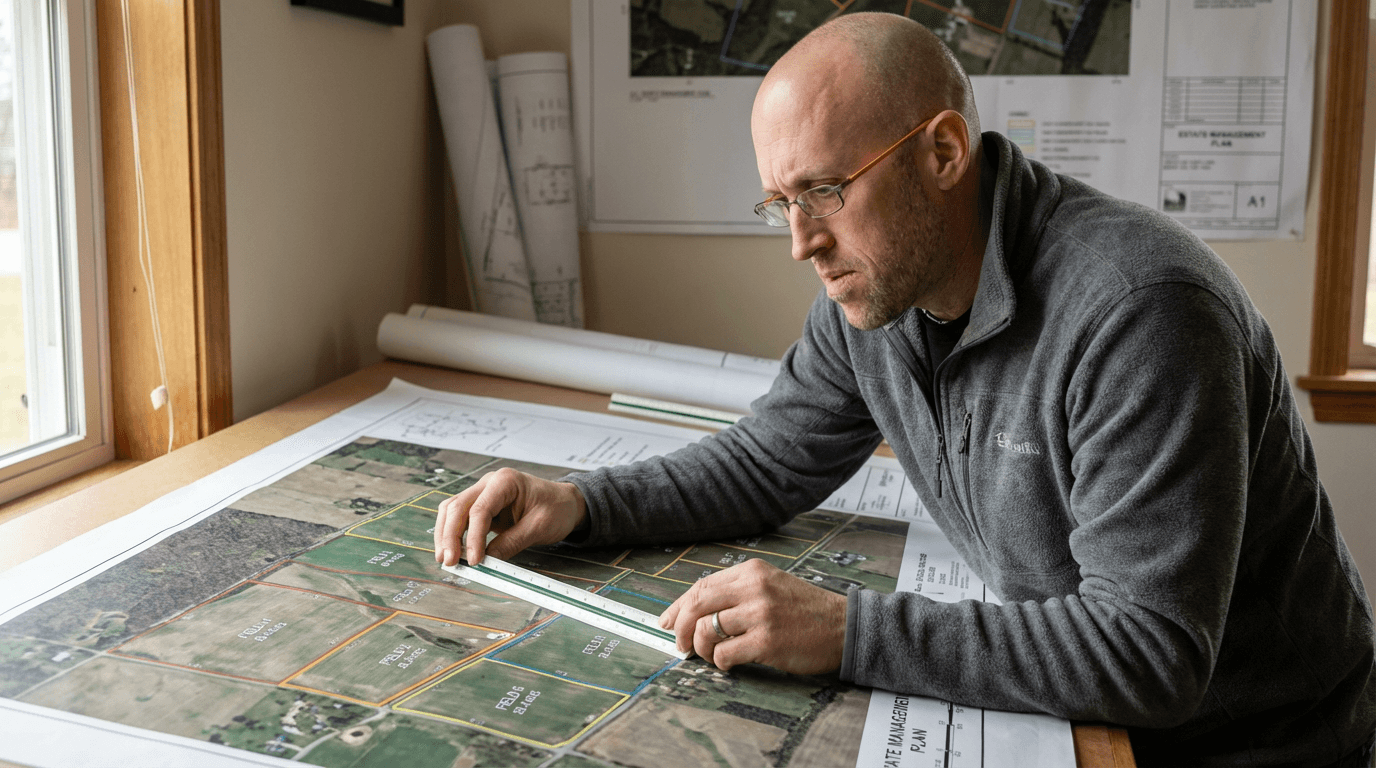

If you manage a landed estate or farm, you'll know the problem: information scattered across filing cabinets, outdated plans that don't quite match reality, and no easy way to see the whole picture.
You know roughly what you own. You have a general sense of who occupies what. But when someone asks a specific question — “How many acres are in the tenancy at Home Farm?” or “Which fields fall within the nitrate vulnerable zone?” — finding the answer takes longer than it should.
Modern digital mapping changes this. Not through complexity, but through clarity.
The Problem with Traditional Records
Most estates have accumulated records over decades. Sometimes centuries. Plans drawn at different times, at different scales, using different conventions. Some accurate, some approximate. Some reflecting current reality, some showing how things were in 1970.
Common issues include:
Inconsistent information
The 1985 estate plan shows field areas in acres. The 1998 tenancy agreement uses hectares. The 2010 stewardship application uses a different boundary. Which is correct?
Ownership versus occupation confusion
You own the land. But parts are let to different tenants, some have informal grazing arrangements, and there's a strip that the neighbour has been using for years. The title plan shows ownership. It doesn't show who's actually using what.
Missing or outdated plans
The farm was split fifteen years ago, but nobody updated the main estate plan. The new barn doesn't appear on any map. The realigned boundary isn't recorded anywhere except in someone's memory.
Difficult information retrieval
When you need to know something specific — which fields are in the Higher Level Stewardship agreement, or where the drainage easement runs — finding the answer means digging through files, cross-referencing documents, and hoping the information exists somewhere.
What Digital Estate Mapping Provides
Modern GIS (Geographic Information Systems) technology allows estate information to be captured, organised, and presented in ways that weren't possible with paper plans.
The core principle is simple: one map that shows everything, with layers you can turn on and off.
Ownership layer
Which land do you actually own? Based on registered titles and measured boundaries, showing the legal extent of the estate.
Occupation layer
Who's using what? Tenancies, grazing licences, informal arrangements — showing the current practical situation, which often differs from the ownership position.
Land use layer
What's each parcel used for? Arable, pasture, woodland, buildings, tracks. Useful for management decisions and record-keeping.
Environmental designations
Which areas fall within SSSIs, nitrate vulnerable zones, flood zones, conservation areas? This information affects what you can do with the land and which regulations apply.
Infrastructure
Where are the tracks, services, water supplies, and other infrastructure? Who's responsible for maintaining what?
Historical information
How has the estate changed over time? Previous boundaries, former buildings, historical uses — sometimes relevant for planning, disputes, or simply understanding why things are as they are.
From Data to Decisions
Good mapping isn't about pretty pictures. It's about information that helps you make better decisions.
Estate planning
When you can see the whole estate clearly — ownership, occupation, land use, constraints — strategic decisions become easier. Which land might be suitable for development? Which tenancies are approaching renewal? Where are the opportunities and the problems?
Tenancy management
Clear mapping of tenanted areas, with linked information about terms, rents, and responsibilities, makes tenancy management more systematic. You can see at a glance which agreements expire when, which areas generate which income, and where boundaries between tenancies lie.
Stewardship and grant applications
Environmental stewardship schemes require accurate mapping of land parcels, uses, and features. Having proper digital mapping makes applications faster and reduces errors. When you can export precisely the data the scheme requires, in the format they need, the administrative burden shrinks.
Sales and acquisitions
Selling part of an estate requires accurate plans. Acquiring additional land requires understanding what you're getting. Good mapping supports both — clear plans for marketing, due diligence for purchases, and easy integration of new land into existing records.
Succession and division
When estates pass between generations, or are divided among beneficiaries, clear mapping is essential. Who's getting what? Where do the boundaries fall? What rights exist over which areas? These questions need precise answers, not approximations.
Day-to-day management
Sometimes you just need to know the area of a field, or check which designation applies to a particular block, or show a contractor where to go. Having the information immediately accessible saves time and prevents errors.
Building an Estate Mapping System
Creating a comprehensive digital estate map isn't a single task — it's a process of gathering, verifying, and organising information. Typically it involves:
Gathering existing information
Establishing the base map
Defining parcels
Adding ownership information
Adding occupation information
Adding designations and constraints
Verification
Creating outputs
The Role of GIS Technology
Geographic Information Systems — GIS — is the technology that makes this possible. At its core, GIS links geographic features (shapes on a map) to database information (attributes and records).
Each field on the estate map isn't just a shape — it's connected to information: its area, its use, its tenant, its designation status, its historical notes. Change the underlying data and the map updates. Query the database and see the results on the map.
Modern GIS software ranges from sophisticated professional systems to simpler tools that provide mapping capability without requiring specialist expertise. The appropriate choice depends on the estate's size, complexity, and management approach.
Integration with Other Systems
Estate mapping doesn't exist in isolation. It can integrate with:
Rural Payments Agency systems
RPA's mapping for farm payments is based on OS data. Properly structured estate mapping can align with RPA parcel data, reducing duplication and inconsistency.
Environmental stewardship records
Stewardship agreements require defined parcel mapping. Estate mapping systems can generate the outputs these schemes require.
Farm management software
Some estates use specialist farm management systems. Mapping data can feed into these, providing the geographic dimension to financial and operational records.
Property management systems
For estates with significant let property, mapping can integrate with property management databases — visual representation of portfolio data.
Common Questions
How long does it take to set up estate mapping?
Do I need special software to use the maps?
How do we keep it up to date?
What about accuracy?
What if I only need mapping for part of the estate?
The Value of Clear Records
There's a reason landed estates have always kept maps. They're essential tools for understanding and managing property.
Digital mapping doesn't change this fundamental purpose. It simply does it better — more accurately, more flexibly, more usefully than paper plans accumulated over decades.
Good mapping is an investment in better management.
Summary
Estate mapping has evolved from hand-drawn plans to sophisticated geographic information systems. The underlying purpose remains the same: clear, accurate records of what you own, who uses it, and what affects it.
Modern digital mapping provides:
- Accurate parcel boundaries based on OS data
- Layered information showing ownership, occupation, and use
- Environmental and regulatory designation overlays
- Calculated areas for each parcel
- Flexible outputs for different purposes
- A foundation for ongoing management
For estates with complex landownership, multiple tenancies, or environmental designations, proper mapping isn't a luxury — it's a practical necessity.