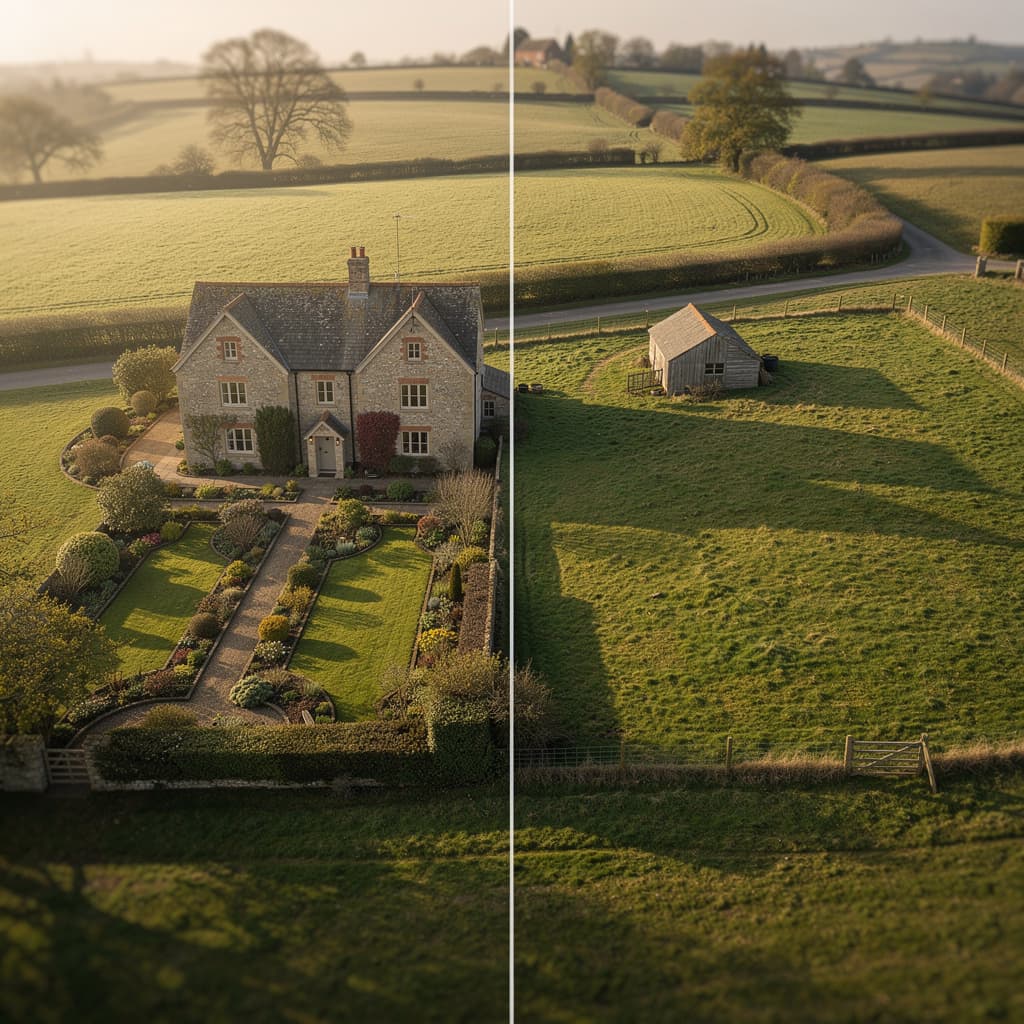

Selling or transferring part of a property — rather than the whole — involves additional complexity. The Land Registry needs to know exactly what's being transferred, what's being retained, and how the two relate to each other.
This guide explains the process, the plans you'll need, and common issues to avoid.
What is a Transfer of Part?
A transfer of part occurs when an owner sells or transfers a portion of their land while retaining the rest. Common examples include:
- Selling a building plot from a larger garden
- Transferring a field from a farm
- Splitting a property between family members
- Selling a house while retaining an adjoining paddock
- Conveying an access strip or ransom strip
Each transfer of part creates a new registered title for the transferred land, while updating the original title to show what's retained.
Why It's More Complex Than Selling a Whole Property
When you sell an entire registered property, the Land Registry already has a title plan showing the extent. The buyer gets everything within the red line.
With a transfer of part, there's no existing plan of the part being sold. You're creating a new boundary — or at least defining one that wasn't previously mapped. This requires:
- A new plan showing the part being transferred
- Clear boundary definition so both parties know exactly what's included
- Consideration of access, services, and rights that affect either part
The Plans You Need
Transfer plan (essential)
The transfer deed must include a plan showing the land being transferred, edged in red. This plan must meet Land Registry requirements:
- Correct scale for the area type (1:1,250 urban, 1:2,500 rural)
- Based on OS mapping (typically MasterMap data)
- Clear red edging around the transferred land
- North point and sufficient surrounding context
- Legible quality that reproduces clearly
The transferred land is edged red. The retained land can be edged blue if helpful for clarity.
New boundary considerations
If you're creating a new boundary — for example, drawing a line across a garden to sell a building plot — the plan needs to show exactly where that boundary will be.
This sounds straightforward, but problems arise when:
- The boundary doesn't follow a physical feature — A line drawn on paper but not marked on the ground causes future confusion. Where exactly does Plot A end and Plot B begin?
- Features will be created but don't yet exist — You might intend to build a fence, but until it's there, the boundary is just a line on a plan.
- The intended boundary is ambiguous — “Along the hedge” — but which side of the hedge? Or through the middle?
For simple cases, the boundary can be described by reference to existing features or measurements from fixed points. For complex cases, a measured survey showing exactly where the new boundary will run is advisable.
Creating New Boundaries
When you transfer part, you're typically creating at least one new boundary. This is the line that didn't previously exist — the division between what's sold and what's kept.
Best practice for new boundaries:
Follow physical features where possible
Boundaries that follow identifiable features are easier to register and less likely to cause future disputes:
- Existing fences, walls, or hedges
- Building lines
- Established paths or tracks
- Watercourses
If no feature exists, create one
If the new boundary runs across open land, consider what will mark it:
- Will a fence be erected?
- Will a hedge be planted?
- Will survey marks be installed?
The transfer deed can specify that a boundary feature will be erected, and by whom.
Measure precisely where necessary
For new boundaries that must be in a specific position — perhaps a defined distance from a building, or following a particular line — a measured survey establishes exactly where that line falls.
We can survey the existing features, mark the proposed boundary position, and produce plans showing the precise division.
Access and Rights
Transfers of part often involve rights that benefit or burden the divided land:
Rights of way
If the transferred land is landlocked — no direct access to a public road — it will need a right of way over the retained land (or vice versa). This must be granted in the transfer.
Think carefully about:
- The route of any access
- What vehicles can use it
- Maintenance responsibilities
- Whether the right benefits just this land or can be extended
Service rights
Utilities (water, electricity, drainage) often cross property boundaries. When land is divided:
- Does the transferred land need rights over the retained land for services?
- Does the retained land need rights over the transferred land?
- Who maintains shared infrastructure?
Other rights
Depending on the situation, you might need to consider:
- Rights to maintain boundaries
- Rights of support for buildings
- Restrictions on use or development
- Rights to enter land for specific purposes
These rights should be specified in the transfer deed. Your solicitor will advise on what's appropriate, but the surveyor's plan provides the factual basis for defining where rights apply.
Common Problems
Based on our experience, transfers of part go wrong for several common reasons:
Ambiguous boundaries
Solution: Show boundaries precisely on the plan, with measurements where necessary. Consider surveying the boundary position if there's any ambiguity.
Features that don't match the plan
Solution: If in doubt, survey the actual position of features and base the plan on measured reality, not assumed mapping.
Missing access rights
Solution: Think through access requirements carefully before completion. Grant appropriate rights in the transfer.
Utility complications
Solution: Investigate service routes before dividing land. Grant appropriate rights for services that cross boundaries.
Plans rejected by Land Registry
Solution: Use compliant plans from the start. We check all our plans for Land Registry compliance before delivery.
The Survey Process for Transfer of Part
When we're producing plans for a transfer of part, the process typically involves:
Understanding the proposed division
We need to know:
- What's being transferred and what's retained?
- Where will any new boundaries run?
- Are there features marking the new boundary, or is it defined by measurement?
Site assessment
For complex cases — particularly where new boundaries are being created or existing features need verification — a site survey is advisable. This establishes exactly where features are and allows precise positioning of new boundaries.
Plan preparation
We prepare the transfer plan based on OS data (and site survey where applicable), showing:
- The transferred land edged red
- The retained land edged blue (if helpful)
- Any new boundaries clearly defined
- North point, scale, and context
Compliance check
Working with Your Solicitor
The transfer plan is part of a legal process. Your solicitor prepares the transfer deed; we provide the plan that goes with it.
Good coordination helps:
- Early involvement — Ideally, we're involved before terms are finalised, so plan requirements can inform negotiations
- Clear instructions — We need to know exactly what's being transferred, including any areas of uncertainty
- Draft review — We can review draft plans before the transfer is finalised, catching problems early
- Timely delivery — We understand transactions have deadlines; we'll work to your timescales where possible
If your solicitor has specific requirements for the plan format or content, let us know. Different firms have different preferences.
Costs
Transfer of part plans vary in cost depending on complexity:
Desktop Plans
Surveyed Plans
We can advise on the appropriate approach based on your specific situation.
The cost of getting it wrong — registration rejection, future disputes, unclear rights — far exceeds the cost of doing it properly. A clear, compliant plan and properly drafted rights protect both parties and save problems later.