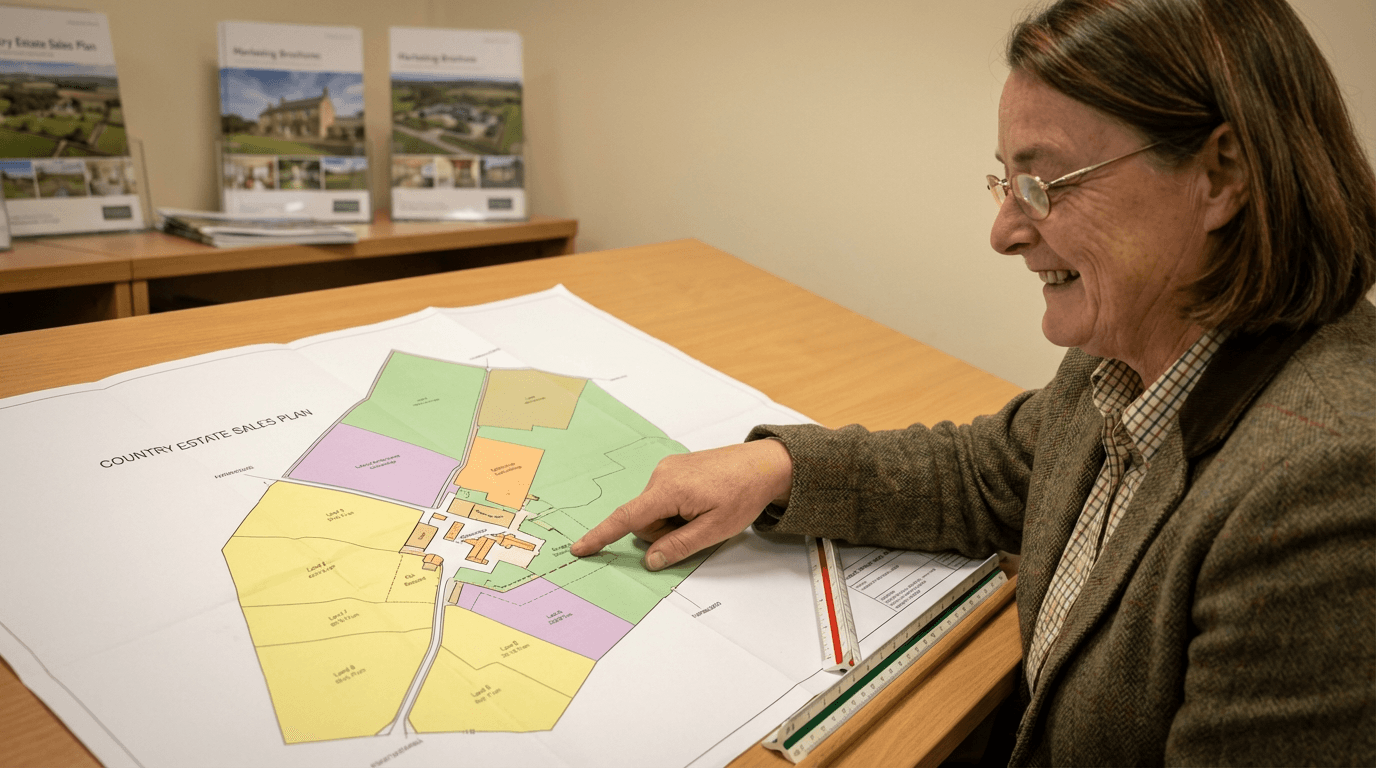

A property is only as sellable as its presentation.
Estate agents understand this instinctively for houses. Professional photography, carefully written particulars, properly staged rooms. First impressions matter. Buyers make emotional decisions before they rationalise them.
The same principle applies to land and rural property — often with higher stakes. A farm, an estate, a development site. These aren't impulse purchases. Buyers are making significant commitments, often competing against others for the same opportunity.
The sales plan is frequently the first thing a prospective buyer studies in detail. It shapes their understanding of what's being offered before they ever visit the site. Done well, it makes the property easier to understand, easier to value, and easier to buy.
What a Sales Plan Actually Does
A sales plan isn't just a map with a red line around the property. It's a communication tool with several jobs to do:
Shows what's included
The fundamental question: what am I buying? The plan should make this immediately clear. The extent of the property, the relationship between different elements, what's in and what's out.
For complex properties — farms with multiple parcels, estates being sold in lots, land with retained areas — this clarity is essential. Confusion about what's included causes problems throughout the transaction and beyond.
Explains the layout
How does the property work? Where's the house in relation to the land? Which buildings serve which purposes? How do you access different parts?
A good plan helps buyers understand the property before they visit, so they arrive with a mental map already forming. It also helps them remember what they saw afterwards — connecting their site experience to a clear visual reference.
Supports the marketing narrative
Every property has a story. The plan should support it.
A compact residential farm with everything close to hand. A ring-fenced block of productive arable land. A development opportunity with road frontage and services nearby. The plan visualises what the particulars describe.
Enables comparison
Serious buyers compare properties. They look at several farms, or several development sites, or several estates. Plans that are clear and professional make comparison easier. Plans that are confusing or amateurish make buyers work harder — and that's rarely to the seller's advantage.
Provides a reference for negotiation
Once interest is established, conversations become specific. “I'm interested in Lot 2 but not Lot 3.” “Could the boundary be adjusted to include the barn?” “What's the access arrangement for the retained land?”
A clear plan makes these conversations productive. Everyone's looking at the same thing, understanding the same information. Ambiguity, on the other hand, creates misunderstandings that complicate negotiations.
Elements of an Effective Sales Plan
The base mapping
Most sales plans are built on OS MasterMap data — accurate, detailed, and familiar to professionals working in property. For rural land, this is often supplemented with aerial photography, showing field patterns, vegetation, and landscape context that line mapping alone can't convey.
The choice between line mapping and aerial photography (or a combination) depends on the property and the audience. Aerial imagery has immediate visual impact. Line mapping is clearer for technical assessment. Many plans use aerial for the main view with line mapping insets for specific details.
Clear boundaries
What's being sold must be unambiguous. Typically shown as a bold red edge around the property, with sufficient contrast against the base mapping to be immediately visible.
For lotted sales, each lot needs distinct identification — usually different colours, clearly numbered, with a key explaining what each lot contains.
Accurate areas
Buyers need to know how much land they're getting. Areas should be clearly stated, either on the plan itself or in an accompanying schedule. For farms and rural estates, areas are typically shown in acres and hectares.
Relevant context
The plan should show enough surrounding context for the property to be understood in its setting. Access roads, neighbouring properties, nearby features. Not so much that the property gets lost in its surroundings; enough that a buyer can understand the location.
Supporting information
Depending on the property, the plan might usefully show:
- Building locations and uses
- Field numbers for reference
- Access points and rights of way
- Services and infrastructure
- Environmental designations
- Development constraints or opportunities
The appropriate level of detail depends on the property and the likely buyers. A development site needs different information from a let agricultural investment.
Professional presentation
This is marketing material. It should look professional — consistent styling, appropriate branding (if the agent wishes), clean typography, proper layout.
This doesn't mean elaborate graphics for their own sake. Rural property buyers are typically practical people; they want clarity, not decoration. But a plan that looks professional signals that the sale is being handled professionally.
Lotted Sales: Additional Complexity
When a property is offered in lots — buy the whole, or buy individual parcels — the plan becomes more complex and more important.
Clear lot identification
Each lot needs to be instantly identifiable. Colour-coding is standard — Lot 1 red, Lot 2 blue, Lot 3 green, and so on. The colours should be distinct enough to differentiate easily, even for colour-blind viewers.
Each lot should be clearly labelled, with a key or legend explaining what's included.
Lot schedules
An accompanying schedule typically lists each lot with:
- Description
- Area (acres and hectares)
- Key features
- Guide price (if disclosed)
The plan and schedule should cross-reference clearly. A buyer looking at Lot 3 on the plan should be able to find Lot 3 in the schedule instantly.
Whole and parts
Often the property is offered as a whole or in lots. The marketing needs to support both possibilities — showing how the lots work individually while also presenting the property as a coherent whole.
This is a design challenge. Too much emphasis on lots can make the whole seem fragmented. Too little differentiation and buyers can't assess individual lots properly.
Retained land and access
If the seller is retaining land, this should be clear. If access to sold lots crosses retained land (or vice versa), the arrangement needs to be shown. Rights of way, shared access, ransom strips — all potential complications that the plan should address rather than obscure.
Common Problems with Sales Plans
Inaccurate or unclear boundaries
If buyers can't tell exactly what's included, they can't make informed offers. “The field to the south” isn't good enough when there are three fields to the south and two of them are actually owned by someone else.
Outdated base mapping
OS mapping is excellent but not instantaneous. Features change — new buildings, removed hedges, altered boundaries. A plan based on outdated mapping misrepresents the property.
For significant sales, it's worth checking that the base mapping reflects current reality.
Missing or incorrect areas
Areas matter for valuation. A farm marketed at 500 acres that turns out to be 460 acres has a problem. The error may be historical (wrong figures carried forward for years) or methodological (areas estimated rather than calculated), but either way it damages the sale.
Poor reproduction quality
Sales plans appear in printed brochures, online listings, email attachments, and presentation screens. They need to work in all these contexts — clear at different sizes, legible when printed, visible when viewed on phones.
Plans designed only for A3 printing may become illegible at smaller sizes. Colour schemes that work on screen may print poorly. Testing plans across likely use cases catches problems before they reach buyers.
Inconsistency with particulars
The plan and the written particulars should tell the same story. If the particulars describe “about 350 acres of productive arable land” and the plan shows 320 acres, there's a problem. If the particulars mention a barn and the plan doesn't show it, buyers will wonder what else has been overlooked.
Working with Estate Agents
We produce sales plans for estate agents across the country — from local firms selling individual farms to national practices marketing major estates.
The process typically involves:
Understanding the property
Gathering information
Agreeing the approach
Producing drafts
Final delivery
Supporting the sale
Fast Turnaround When Needed
Property sales often move quickly. Instructions come in, and the agent needs marketing materials soon — sometimes very soon.
We understand this. Our standard turnaround is measured in days, not weeks. When urgency is genuine, we can often turn work around same-day or next-day.
Beyond the Sale
The plans we produce for marketing often continue to be useful after the sale completes.
A well-produced sales plan provides:
- A clear record of what was sold
- A reference for boundary positions
- A basis for future management planning
- Context for subsequent transactions
We keep records of work we've done. If you need copies, updates, or variations of previous plans, we can usually help.
Summary
Sales plans are marketing tools, but they're also technical documents. They need to be attractive enough to support professional marketing and accurate enough to withstand professional scrutiny.
The farms and estates we produce plans for represent significant assets — often the largest transactions our clients will ever make. The plan is often the first detailed engagement a buyer has with the property. It's worth getting right.